Education · Policy News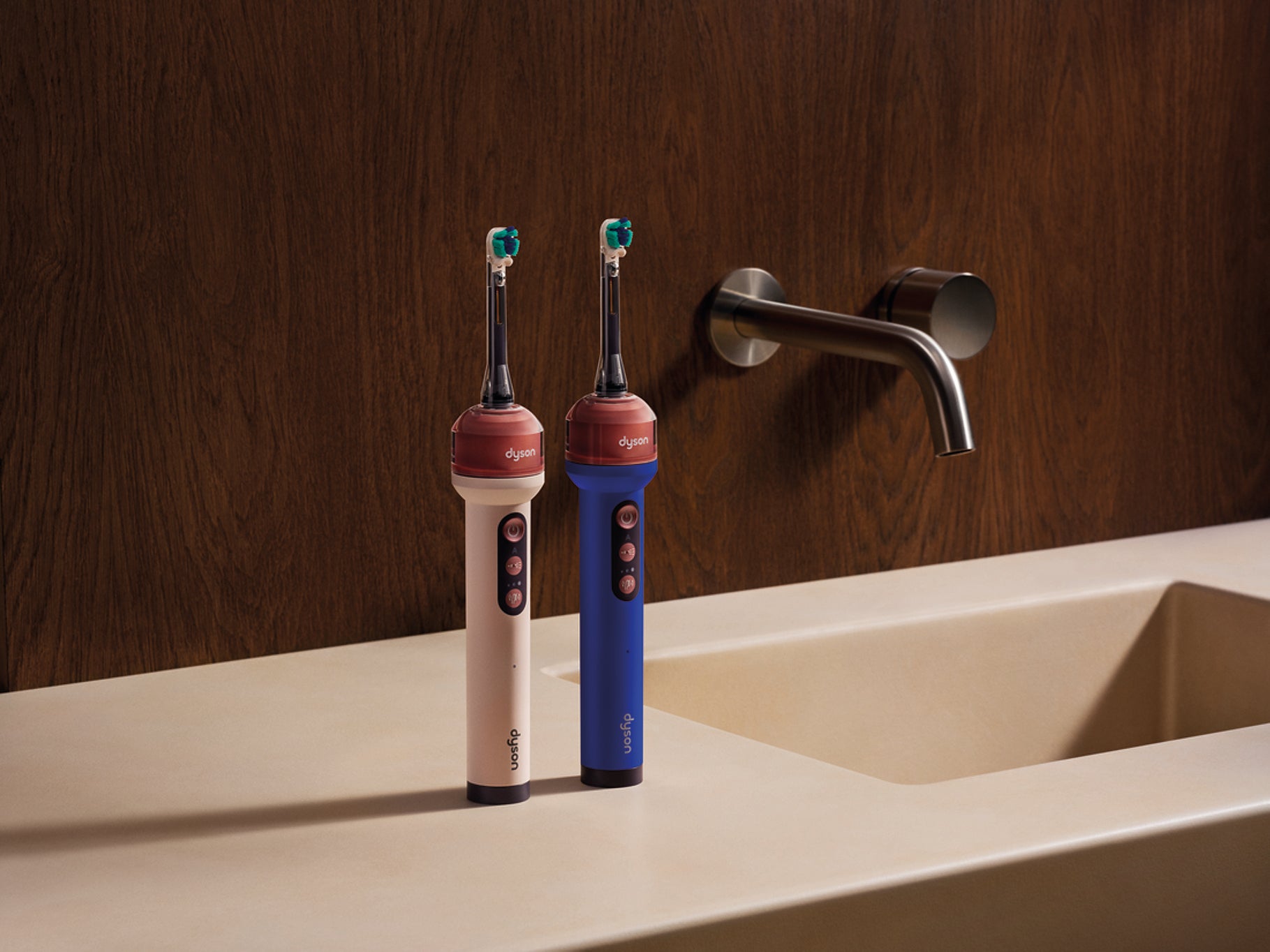
James Dyson ’s latest product is an innovative new toothbrush, the Dyson CameraJet. It’s called that because it has a camera which, even though it’s vibrating at 58,000 times a minute inspects the inside of your mouth. As the brush passes the gaps between teeth , it spots them and sprays mouthwash from a built-in reservoir to remove plaque while you brush.
I sat down with Sir James during a recent heatwave, when, despite the hot weather burning out the lift in his apartment block, leaving him to climb six storeys at the end of the day, he was on lively, positive form. The Dyson CameraJet has 38 patents to its name, and has been worked on by 661 Dyson engineers over its six years’ development. Sir James has spent much of his career reinventing products, like removing the bag from a vacuum cleaner, creating fans without blades and more.
The move to dental health is a different direction, so I asked how it came about. “It’s pretty simple really,” he explained. “I’ve been trying to clean my teeth, look after my teeth like everybody else.
I have to brush them, floss them, and I have this sort of interdental brush. Every time I go to the hygienist, she goes at me with a pickaxe, hacking hard lumps off my teeth,” he said. (Dyson) Sir James realised that most people don’t really like to floss. “I think it’s only one out of ten people who actually floss and people spend far too little time in the brushing process in each session.” So, he asked, “Why can’t you jet between the teeth while you brush?
Why can’t you do them both in one action?” I’ve been using the CameraJet for just over a week and the combination of brushing and flossing leaves the mouth feeling remarkably clean and fresh, though the technique required can be quite a splashy experience. The biggest challenge was figuring out where the gaps between the teeth are – in real time, while the toothbrush is moving around inside the mouth. “You need light to see in the dark mouth and a camera to see where the gap is,” Sir James said, “And you need to fire the correct type of jet between the teeth.
It sounds simple, but it’s quite difficult because you need quite a clever camera. The brush head is vibrating at a very high speed. So, by the time you’ve sent the signal and fired the jet, you’ve gone past the gap.
You have to anticipate the gap. You have to know it’s coming and know what speed it’s coming at.” That meant a “massive amount” of software. “I think it’s 16 million lines of code, and then you need the correct shape of jet,” Sir James explained.
A narrow, needle-like jet, found on other water pick flossers, might sound effective, but Sir James said it simply punctures the plaque rather than moving it. Instead, the toothbrush uses a conical jet to spray the plaque more effectively, without causing pain. The camera needs to synchronise with the movement of the brush.
“We almost match, just slightly out of sync, the frequency of our light and the camera,” Sir James said. The system has a light, camera and jet positioned at the top of the brush stem, beneath the removable head, and then there is the toothpaste. A conventional foaming toothpaste could interfere with the camera's ability to see, so Dyson engineers developed a non-foaming formulation.
There are already non-foaming toothpastes from brands like Sensodyne and Corsodyl, but most toothpastes create a foam in the mouth using something called sodium lauryl sulphate. “We had to develop is a camera that could see in the dark, but also with the presence of toothpaste, foam, saliva and everything else,” he said. “It’s like putting your iPhone down in your washing-up bowl and wanting it to film accurately what’s going on in the washing-up bowl.
It is so difficult.” As a result, the camera system was the part of the process that took the longest to develop, and he drew a comparison with pheasant shooting. “You can’t shoot at the pheasant, you’ve got to shoot in front of the pheasant,” he said. “If you shoot at the pheasant, your shot goes behind it and the pheasant sort of waggles its tail and clears off.” The same applies to the toothbrush.
“You’ve got to know the speed they’re going. You’ve got to know the shape of their teeth to anticipate that gap,” he said. “We’ve been involved with cameras for some time, because we’ve used them on our robotics.” The toothbrush seems to work, then, as a combination of domestic robotics and dental care.
“It’s a bit like the robot in the house going around your teeth,” he said. “We did literally talk about it in those terms.” And it should get better as time goes on. “It will learn your mouth and will get better and better at finding the gaps,” Sir James said.
The toothbrush uses a different brushing rhythm designed to prevent the bristles from “stalling”, and it uses a conical jet to spray between the teeth. This is arguably better than the needle jets used on some water flossers as it can be gentler while sweeping away more plaque. In my first week of using the toothbrush, it certainly leaves your mouth feeling clean and refreshed.
“You will get improved gum health, less gum disease, and fewer sore gums with our system,” Sir James claimed. Part of that may be down to motivating people to clean their teeth and gums better. “You put the toothpaste on and there’s a tendency just to get it over with,” Sir James said.
“As long as I’ve gone over the teeth, that’s done it.” “With the CameraJet, you can brush and floss and improve the gum health,” Sir James said. “The fact that it’s starting to do interesting things makes teeth brushing interesting, not a chore.” Sir James’s products often cost a lot more than the competition, but routinely include high-quality components and considerable innovation. In fact, the price of this toothbrush, £419.99, though far from cheap, is not the most expensive on the market.
I wondered if with a new product a company like Dyson just wants to get the product right and the price doesn’t come into the equation. “I mustn’t say that I don’t think about it. I want to design products that do something really well and often, hopefully, unusual things that haven’t been done before.
There is a cost to that. We have to make a living. But when you’re first going into production with something new, inevitably it costs more than existing products.
And I’m sure that’ll be the case with the toothbrush. It means fewer visits to the dentist,” Sir James said, suggesting that there will be cost savings in another way further down the line if fewer dental procedures are necessary. “I hope people like it,” he said, and that’s not a certainty.
The company’s electric car famously never made it to market. “I don’t always get it right, who knows?” he said. “But luckily, some do work.
In a way, that’s the wonderful side to it. It’s not a given. You don’t know how many you’re going to sell.
It is a gamble and life lives on hope.” There are other products being announced by Dyson right now, including robot vacuums which also mop and the first mains-powered vacuum cleaner in years. It’s a new colourway for an established model. “We’ve been concentrating on improving battery ones,” Sir James said.
“But there are still people who want mains ones for whatever reason. We’re doing a new one for them with some of the things that we’ve learned from making the battery machines. It’s still a big market.
And of course, we want to update what we’re doing.” There’s a new haircare product and a giant air purifier which can remove smoke and other pollutants from a large area in a matter of seconds. But it’s the toothbrush that will steal the show. So, how does Sir James feel about potentially putting hygienists out of work?
“I’ve been using the brush for about a year,” he said. “When I go to the hygienist now, she doesn’t get out the pickaxe. She says, ‘Oh you’ve got a bit of a stain on that tooth there.’ So, she spends the half hour dealing with things that she would never have dealt with before because she was spending her time pickaxing.
So, they won’t lose their jobs, they’ll move on to doing better things with our teeth.”
Source: The Independent